
When the art stops innovating, can the branding become the art?
Inside Taylor’s Marketing Mastermind


Two 20-something dudes walk down a street in New York’s art district, passing a three-block line.
“Hey, is Taylor Swift actually in there?”
They look confused.
The guard in a black tuxedo and hat just shakes his head.
Do they sell anything inside? Also no.
The line isn’t for a concert or a store. It’s for a Taylor Swift pop-up. It sells nothing, yet the line is around the block.
A few steps away, two teenage girls rush toward another group just leaving the orange-and-blue-branded space. They ask the obvious question: Is it worth waiting hours in line?
One girl explains:
“We waited 30 minutes for it to open and spent another 30 inside. It feels like a personal museum, full of photo ops, exactly like Instagram. You can just watch the Stories, but being there feels… intimate. Like stepping into her mind.”
“Mastermind,” another girl adds. Everyone giggles.


What looks like chaos on a Chelsea sidewalk is actually a masterclass in fandom strategy, and, maybe, in how to keep the illusion of intimacy alive when the art itself has stopped pleasing us.
The Life of a Superfan (and of a Professional Fan)
We need to talk about Taylor Swift’s launch strategy.
As you, dear reader, may know, I’ve done my share of fandom work: Marvel, SoundCloud, you name it.
The biggest difference between good and great fandom strategy lies in how we define a fan.
Good fandoms treat fan as a noun.
Great creators know that to fan is a verb.
Good fandoms invite attention; great ones cause action.
To fan, in Swift’s world, means to decode and create, to hypothesize. It means being in the story yourself.
Taylor Swift’s The Life of a Showgirl pop-up is exactly that: a live, physical call to action.
But there are also the professional fans, people who run accounts like SwiftiesForEternity or TaylorSwiftUpdates13. They are powerful unofficial marketing teams, archiving, decoding, and amplifying every Swift move in real time. They take one small pop-up and send it rippling across continents.
Bias, Disclosed
I’m not a Swiftie (or at least I don’t think I am). But I do write a lot about her cultural reach and impact, and full disclosure, I don’t like the new album any more than anyone else.
The Life of a Showgirl is rough. It’s been panned by critics, ignored by casual listeners, and even the faithful are struggling to defend it. Look closely, and you find not hidden genius but a strange bitterness, a self-regard that makes the whole thing uneasy. The cultural story isn’t in the songs; it’s in how the launch works despite them.
I’ve come to expect her, of all people, to define what’s next, to bend the conversation. This time, the conversation feels scripted, and quite badly scripted at that.
And yet, the launch worked. The numbers are staggering, the coverage relentless: Taylor Swift Breaks Adele’s Record for Biggest Album in a Single Week, Passing the 3.5 Million Units Mark.
Which forces the uncomfortable question: When the art stops innovating, does the marketing become the art?
In an earlier piece, I argued she’s underrated because the only fair historical comparison might be William Shakespeare. But now I think we’re watching what happens when the author becomes her own publisher, promoter, and protagonist all at once.
Scalable Intimacy
If anyone can make the oxymoron of scalable intimacy real, it’s Taylor.
The pop-up sells nothing. Instead, it takes fans into her mindspace to hunt Easter eggs: hints and clues about the upcoming album.
Marketed as half dare, half call to arms, Taylor asks:
Can you outsmart me? Can you find what I’ve hidden?
It’s fun, participatory, and delivers what every brand dreams of: earned media — and emotional investment that feels like friendship.
The Tradition of the Easter Egg
In Swift’s universe, an Easter egg isn’t chocolate. It’s a clue: a hidden lyric, color choice, or prop that hints at what’s coming next.
For fans, decoding these details is an embedded ritual. The pop-up simply brings that tradition into the real, public space.
In the many nooks and crannies, fans find messages and props — like a note reading “Thank you for the lovely bouquet”— believed to be a lyric from the upcoming album.
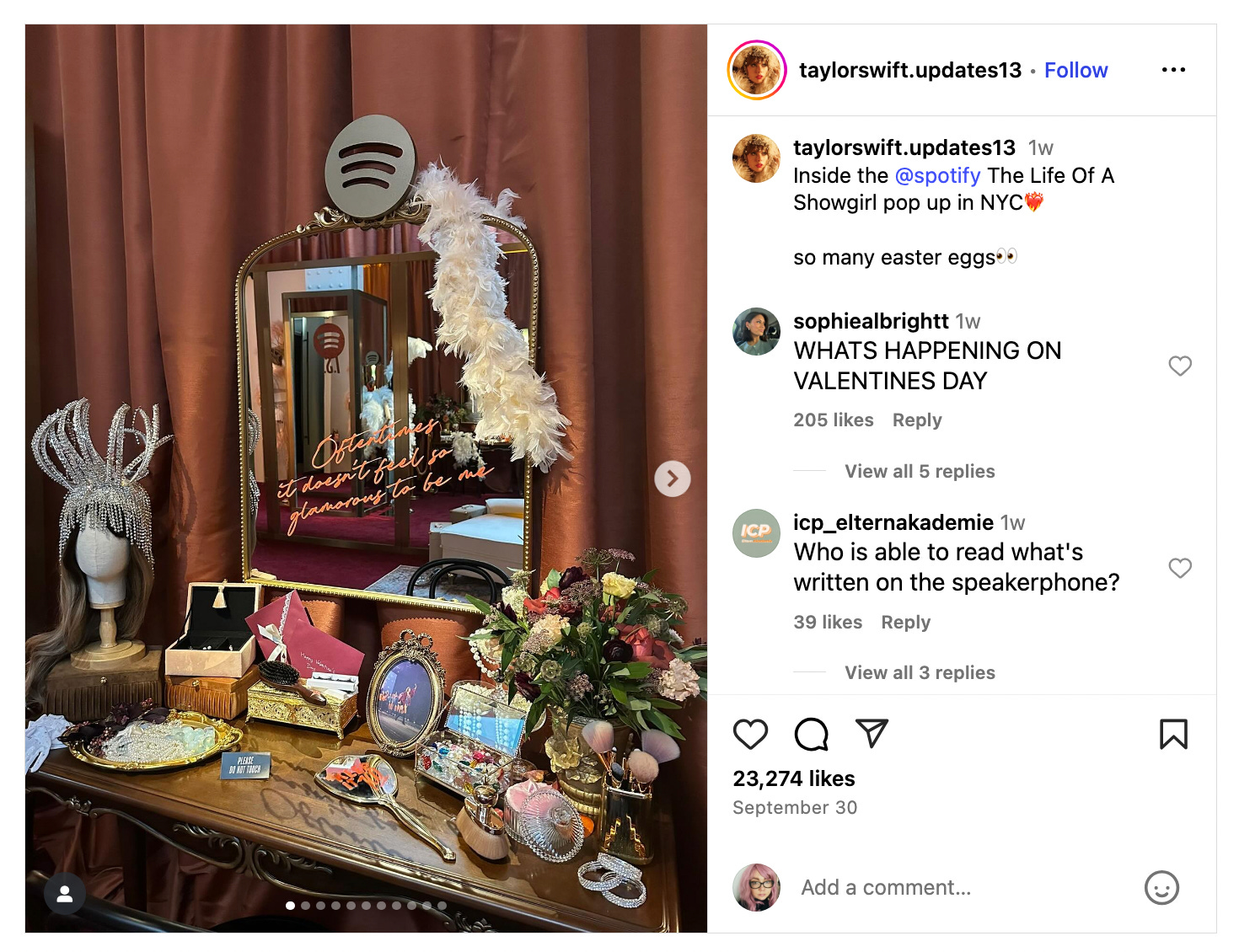
Every clue turns into conversation; every conversation becomes free promotion. The less she shows, the more they seek.
One clue, written on a mirror, read: “Oftentimes it doesn’t feel so glamorous to be me.” Within hours, it was on IG.
Is it a lyric? A reference? A clue?
Maybe.
The Fate of Ophelia. Elizabeth Taylor. Eldest Daughter.
The decoding begins.
Cluttered Genius
The pop-up itself is small and cluttered, a mix between a backstage green room and a future museum.
Velvet curtains. Handwritten notes. Mirrors reflecting other mirrors.
You’re stepping into someone’s unfinished scrapbook — the illusion of access to a process that might no longer be purely musical.


It’s a physical manifestation of creative messiness, imagination in mid-process. And yes, maybe I do sound like a Swiftie. Or maybe I’m just watching someone who turned branding into autobiography.
Why It Works
There’s only one place where 14-year-olds and 40-year-olds compete for the same scarce resource: a few minutes inside Taylor Swift’s world.
This pop-up intimacy, this glimpse behind the curtain, is why Taylor Swift feels relatable despite her scale.
Millions follow her, but each fan feels personally invited backstage.
To enter that world, though, you wait: five or six hours in line. Some play board games in sparkly outfits. Others take work calls, edit Excel sheets, or read novels in fall cardigans Swift would approve of.


And that’s the paradox Taylor keeps mastering — making a global phenomenon feel like a secret between friends.
The art itself may not always deliver that feeling anymore, but the ritual around it still does. And when the music falters, sometimes it’s the branding that carries the melody — and becomes indistinguishable from the art itself.